From deconstructed man to deconstructed home?
The other day, I was talking to a friend I hadn't seen in a long time. He explained that he had recently found an unexpected outlet for expressing his negative emotions.
After several difficult weeks, worn down by his work and personal life, he visited his cousin and was on the verge of exploding. His cousin welcomed him, led him into the living room, and introduced him to their latest invention: the "crying sofa."
On the wall, an A4 sheet of paper hung above one side of the sofa, renamed "the crying corner." The flannel cushions had already been "inaugurated" by her boyfriend, then by her cousin herself. My friend played along. He explained to me how liberating this simple staging had been.

When space becomes therapeutic
I then told him that in certain group therapies, objects, furniture, and even the spatial configuration actively participate in the therapeutic exercise.
This is the case with psychodrama, theorized in the 1920s by Zerka Toeman Moreno and Jacob Lévy Moreno. The principle? Re-enacting a traumatic situation in theatrical form. Participants play roles, but objects do too: a cushion can become a parent, an emotion, or a source of anxiety.
Moving this object, placing it further away, bringing it closer, concealing it, placing it in the center or on the periphery of the room, becomes a symbolic and cathartic gesture. The space acts as a partner in care: it provides a safe environment and opens up new perspectives for action.
Space, especially domestic space, is never neutral. It reflects and shapes our inner world.
The domestic space, still too rigid
In the complexity of our Western lifestyles, caught between pressing environmental and political issues, it is striking to note how our conception of domestic space—as a society, and particularly for us as designers—remains archaic and single-oriented.
Each room is assigned a specific use: the kitchen for eating, the bathroom for washing, the bedroom for sleeping, the living room for socializing.
However, if we look at history, domestic spaces have often embodied much more than just simple functions. In the Middle Ages, for example, the great hall was used for feasting, administering justice, and asserting power. In Renaissance villas, the layout of the apartments reflected social hierarchies. Closer to home, in the 19th century, the bourgeoisie turned the living room into a stage, where architecture and furniture served to express social status as much as to accommodate everyday life.
Today, even though we are increasingly aware of the cost and scarcity of built space—in terms of finance, land, and energy—we continue to limit our housing to minimal functions.
Yet space could accommodate, superimpose, and embody a multitude of functions, not only practical but also emotional and symbolic.
Towards an “emotional mapping” of the home?
We often talk about the "deconstructed man" of the 21st century. But our relationship with space remains static. What if these two developments could come together?
Imagine a home designed as a safe space, where every emotion has a place to be welcomed. The crying sofa for sadness. The arguing table for channeling anger.
The rest of the space could then be dedicated to other emotions—lighter, happier, more subtle ones.
There might also be a bright, open corner for cultivating joy. An enclosed, muted, and cozy space for retreat.
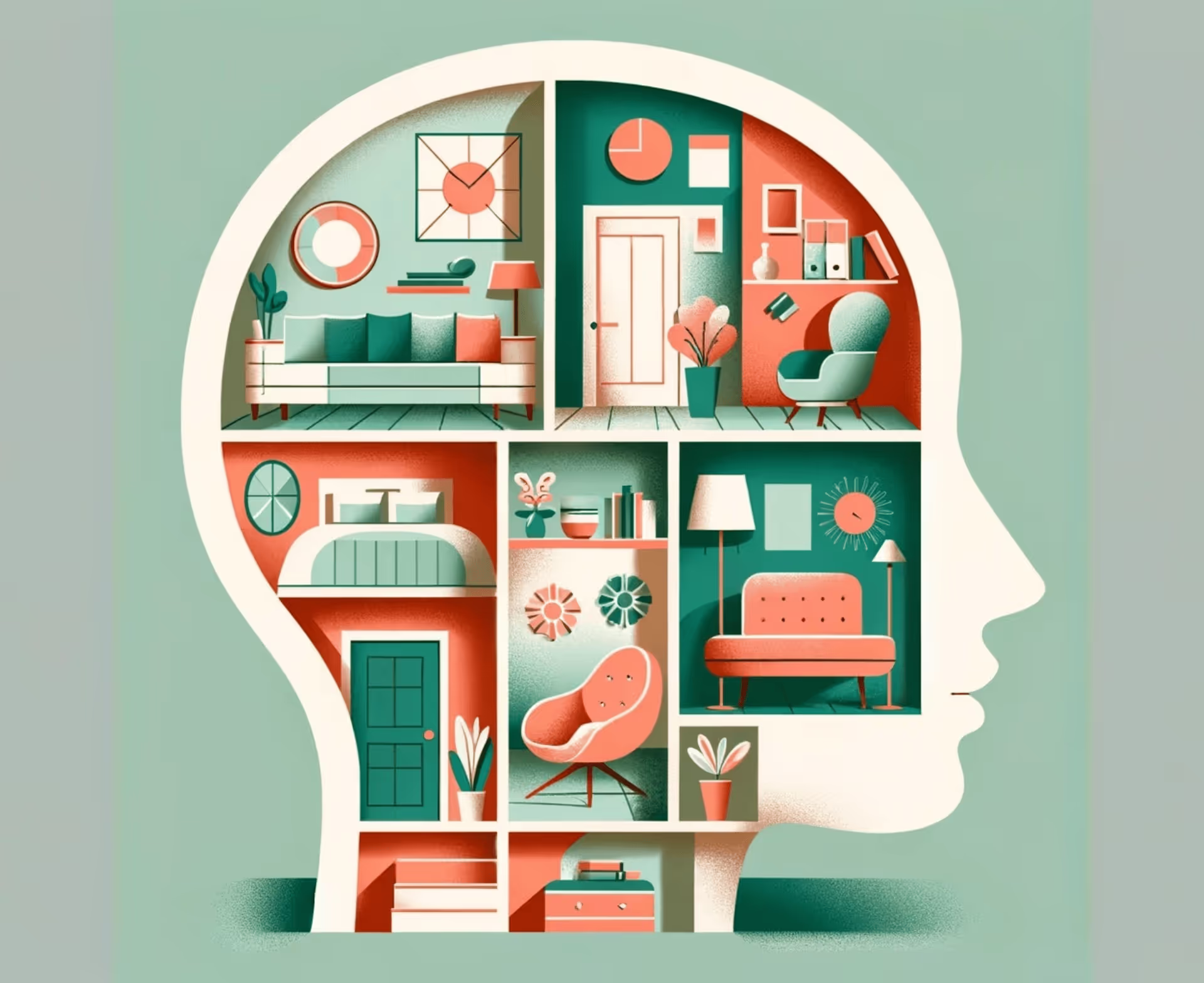
We could thus design an emotional mapping of the interior, corresponding to a sensory map of the house. This could take the form of a simple sign, or a more elaborate setting: special lighting, a range of colors, appropriate textures, and modulation of the space.

Deconstructed domesticity
A deconstructed space would no longer be fixed in conventional uses, but would be fluid, porous, and sensitive. Like the people of the 21st century, the domestic space can open itself up to its contradictions, embrace its ambiguities—and, in this deconstruction, invent new forms of freedom.
Share